
SOLAR AND LUNAR ECLIPSES.
Vaishnava perspective
of the significance of a Graha grasthah - eclipses.
last update 2nd January 2020
 http://spaceweather.com
All information is available for all lunar and solar eclipses for our
region here http://www.rasnz.org.nz/index.htm
ECLIPSES DURING 2020
Eclipse Summary:
------------------------
Eclipse Summary:
11/01/20 Lunar - Penumbral
6/06/20 Lunar - Penumbral
21/06/20 Solar - Annular
5/07/20 Lunar - Penumbral
30/11/20 Lunar - Penumbral
15/12/20 Solar - Total
------------------------
https://www.timeanddate.com/eclipse/list.html?starty=2020
10/01/20 Lunar - Penumbra
10th - 11th January 2020
Mag: 0.887
The Moon is below the horizon during this eclipse, so it is not possible to view it in Tauranga, NZ.
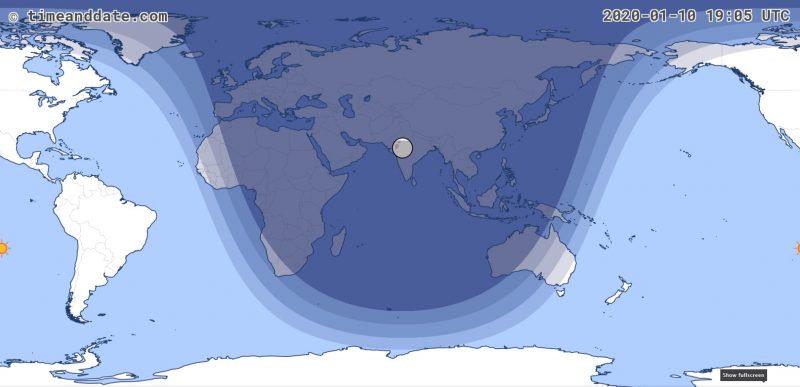
https://astrologyking.com/lunar-eclipse-january-2020/
Penumbral Starts:
11/01/2020 06:08
New Zealand Daylight Time
Mid Eclipse:
11/01/2020 08:09
New Zealand Daylight Time
Penumbral Ends:
11/01/2020 10:10
New Zealand Daylight Time
------------------------
5/06/20 Lunar - Penumbra
5th - 6th June 2020
Mag: 0.559
Visible in Tauranga, NZ
The Moon is below the horizon in Tauranga some of the time, so that
part of the eclipse is not visible.
Penumbral Starts:
6/06/2020 05:46
New Zealand Standard Time
Mid Eclipse:
6/06/2020 07:24
New Zealand Standard Time
Penumbral Ends:
6/06/2020 09:02
New Zealand Standard Time
------------------------
21/06/20 Solar - Annular
21st June 2020
Mag: N/A
Hemisphere: Northern
Mid Eclipse:
21/06/2020 18:39
New Zealand Standard Time
21/06/2020 16:50
New Zealand Standard Time
Lat: Lon: Duration
-60.44 17.99 0.55
21/06/2020 17:00
New Zealand Standard Time
Lat: Lon: Duration
-64.61 20.34 0.51
21/06/2020 17:10
New Zealand Standard Time
Lat: Lon: Duration
-68.37 22.33 0.47
21/06/2020 17:20
New Zealand Standard Time
Lat: Lon: Duration
-71.88 24.02 0.44
21/06/2020 17:30
New Zealand Standard Time
Lat: Lon: Duration
-75.25 25.46 0.41
21/06/2020 17:40
New Zealand Standard Time
Lat: Lon: Duration
-78.52 26.68 0.39
21/06/2020 17:50
New Zealand Standard Time
Lat: Lon: Duration
-81.77 27.68 0.38
21/06/2020 18:00
New Zealand Standard Time
Lat: Lon: Duration
-85.01 28.47 0.36
21/06/2020 18:10
New Zealand Standard Time
Lat: Lon: Duration
-88.28 29.06 0.36
21/06/2020 18:20
New Zealand Standard Time
Lat: Lon: Duration
-91.61 29.44 0.36
21/06/2020 18:30
New Zealand Standard Time
Lat: Lon: Duration
-95.03 29.61 0.37
21/06/2020 18:40
New Zealand Standard Time
Lat: Lon: Duration
-98.57 29.55 0.38
21/06/2020 18:50
New Zealand Standard Time
Lat: Lon: Duration
-102.26 29.26 0.40
21/06/2020 19:00
New Zealand Standard Time
Lat: Lon: Duration
-106.15 28.71 0.42
21/06/2020 19:10
New Zealand Standard Time
Lat: Lon: Duration
-110.31 27.86 0.45
21/06/2020 19:20
New Zealand Standard Time
Lat: Lon: Duration
-114.84 26.66 0.48
21/06/2020 19:30
New Zealand Standard Time
Lat: Lon: Duration
-119.95 25.01 0.52
21/06/2020 19:40
New Zealand Standard Time
Lat: Lon: Duration
-126.01 22.74 0.57
------------------------
5/07/20 Lunar - Penumbra
5th July 2020
Mag: 0.350
Penumbral Starts:
5/07/2020 15:07
New Zealand Standard Time
Mid Eclipse:
5/07/2020 16:29
New Zealand Standard Time
Penumbral Ends:
5/07/2020 17:51
New Zealand Standard Time
------------------------
30/11/20 Lunar - Penumbra
30th November 2020
Mag: 0.823
Penumbral Starts:
30/11/2020 20:33
New Zealand Daylight Time
Mid Eclipse:
30/11/2020 22:42
New Zealand Daylight Time
Penumbral Ends:
1/12/2020 00:52
New Zealand Daylight Time
------------------------
14/12/20 Solar - Total
14th December 2020
Mag: N/A
Hemisphere: Southern
Mid Eclipse:
15/12/2020 05:13
New Zealand Daylight Time
15/12/2020 03:20
New Zealand Daylight Time
Lat: Lon: Duration
99.26 -19.99 1.16
15/12/2020 03:30
New Zealand Daylight Time
Lat: Lon: Duration
93.16 -23.79 1.30
15/12/2020 03:40
New Zealand Daylight Time
Lat: Lon: Duration
88.10 -26.91 1.41
15/12/2020 03:50
New Zealand Daylight Time
Lat: Lon: Duration
83.58 -29.56 1.51
15/12/2020 04:00
New Zealand Daylight Time
Lat: Lon: Duration
79.32 -31.87 1.59
15/12/2020 04:10
New Zealand Daylight Time
Lat: Lon: Duration
75.20 -33.87 2.06
15/12/2020 04:20
New Zealand Daylight Time
Lat: Lon: Duration
71.10 -35.61 2.11
15/12/2020 04:30
New Zealand Daylight Time
Lat: Lon: Duration
66.97 -37.08 2.14
15/12/2020 04:40
New Zealand Daylight Time
Lat: Lon: Duration
62.74 -38.31 2.16
15/12/2020 04:50
New Zealand Daylight Time
Lat: Lon: Duration
58.37 -39.28 2.16
15/12/2020 05:00
New Zealand Daylight Time
Lat: Lon: Duration
53.83 -39.99 2.14
15/12/2020 05:10
New Zealand Daylight Time
Lat: Lon: Duration
49.08 -40.41 2.11
15/12/2020 05:20
New Zealand Daylight Time
Lat: Lon: Duration
44.08 -40.52 2.05
15/12/2020 05:30
New Zealand Daylight Time
Lat: Lon: Duration
38.80 -40.29 1.58
15/12/2020 05:40
New Zealand Daylight Time
Lat: Lon: Duration
33.15 -39.67 1.50
15/12/2020 05:50
New Zealand Daylight Time
Lat: Lon: Duration
27.02 -38.59 1.39
15/12/2020 06:00
New Zealand Daylight Time
Lat: Lon: Duration
20.17 -36.92 1.27
15/12/2020 06:10
New Zealand Daylight Time
Lat: Lon: Duration
12.06 -34.37 1.12
------------------------
https://www.timeanddate.com/eclipse/list.html?starty=2020
http://www.rasnz.org.nz/Eclipses/
Please visit http://spaceweather.com
for eclipse maps, timetables and photos.
(See also NASA's solar eclipse pages and NASA's Lunar eclipse pages)
The world meeting planner is a useful tool in this regard http://www.worldtimezone.com/time/wtzplanner.php?m=8&y=2008#
Map of Solar Eclipses until 2020:
NASA's Solar Eclipse list 2001 - 2010 - 2011 Very useful maps and graphix
Solar Eclipse computer - http://aa.usno.navy.mil/data/docs/SolarEclipse.html
(Longitude and Latitude and Time zone found on top of Vcal calender)
computes circumstances for selected solar eclipses at any given location
(http://aa.usno.navy.mil/)
Lunar Eclipse computer - http://aa.usno.navy.mil/data/docs/LunarEclipse.html
(Longitude and Latitude and Time zone found on top of Vcal calender)
computes circumstances for selected solar eclipses at any given location
(http://aa.usno.navy.mil/)
Scroll down to the red Form B - Locations Worldwide Just type in your town or city and click on Place Name. Then click on Get Data, very simple.
With all Solar & Lunar Eclipses (do not cook, eat, etc. Only Chant Hare Krishna) see eclipses-page
For more details on Graha-grashtha - Solar and Lunar Eclipses please view our page
Here's a new page of quoting what
to do during Solar and Lunar Eclipses


Just a heads up to alert you that next Gaura purnima there will be a total eclipse of the Moon visible in India and hence Mayapura. The eclipse starts after midnight in Mayapura on Gaura Purnima (see details below) so technically by the yavana calendar it will be on March 4, 2007 but since the day starts at sunrise by Krsna's Vedic system it will still be Gaura Purnima day.
For more information go to:
Click on it to enlarge the image.
You will see two diagrams:
1 of the Moon moving through the shadow with annotations such P1, U1, U2 etc
2 of the map of the earth showing where the eclipse will be visible.
On the right hand side between these two diagrams you will see a table of times called "Eclipse contacts" which give you the time in UT - Universal Time--which for all intents and purposes is the same as GMT for non-astronomers like us. To convert it to IST we need just add 5:30.
The important ones are U1-U4 that is when the Moon enters the actual shadow (Rahu) aka the umbra, hence U1 is when it enters and U4 is when it leaves. U2-U3 are the times of maximum eclipse and it will be a total eclipse in which the Moon will look dark red assuming of course that the sky will be clear so as to be visible, which it should be at that time of year.
Note that the eclipse starts (U1) at 3:00 AM IST and ends (U4) at 6:42 IST the ending time will not be visible because the Sun will have risen (6:01AM) in Mayapur by then.
But note that the times of maximum and thus total eclipse U2-U3 will be from 4:14AM-5:28AM and that the sun will not rise until 6:01 AM. That means that basically from 3:00AM till sunrise Mayapura will be subjected to the eclipse with the maximum phase during mangala arotika.
The time for the beginning of the penumberal phase P1 is not relevant to us because for all practical purposes we can not notice any thing and it is of academic interest to astronomers with sensitive light sensing meters. For more explanation of this see:
http://www.hermit.org/Eclipse/why_lunar.html
and read the section explaining it where it says: "From Earth, when the Moon passes through the penumbra we see it dimming due to the reduced light, although in practice this can be hard to see with the eye."
We had experience of such a penumberal eclipse earlier this year and saw absolutely no effect on the Moon. It was a complete dud. So I would just ignore the time between P1 and U1.
But from 3:00 am till sunrise Mayapura Dham will experience the eclipse so what ever measures that are to be taken during such events should be organized. In many temples in S India they close down completely for example even though the September 7, 2006 eclipse is only a very partial eclipse (less than 20%) the Balaji temple is closing. I do not know what standards the Gaudiya Vaisnavas follow for such events but I suppose that this is the time to find out.
Your humble servant
Shyamasundara Dasa

Space Weather News for March 1, 2007
http://spaceweather.com
TOTAL LUNAR ECLIPSE: Set aside some time this weekend for sky watching. On Saturday night, March 3rd, there's going to be a total eclipse of the Moon. This means the Moon will glide through the heart of Earth's shadow and turn a beautiful shade of sunset red. Totality can be seen from parts of all seven continents including all of Europe and Africa and the eastern half of North America.
Visit http://spaceweather.com for observing tips, maps and links to live webcasts.
Lunar Eclipse Gallery (photos from a similar eclipse in 2004): http://spaceweather.com/eclipses/gallery_27oct04_page2.html
If a friend sent you this newsletter and you would like to subscribe, click here: http://spaceweather.com/services/
To unsubscribe click here: http://www.spaceweather2.com/u?id=588200L&n=T&l=spaceweather
or send a blank email to leave-spaceweather-588200L@www.spaceweather2.com